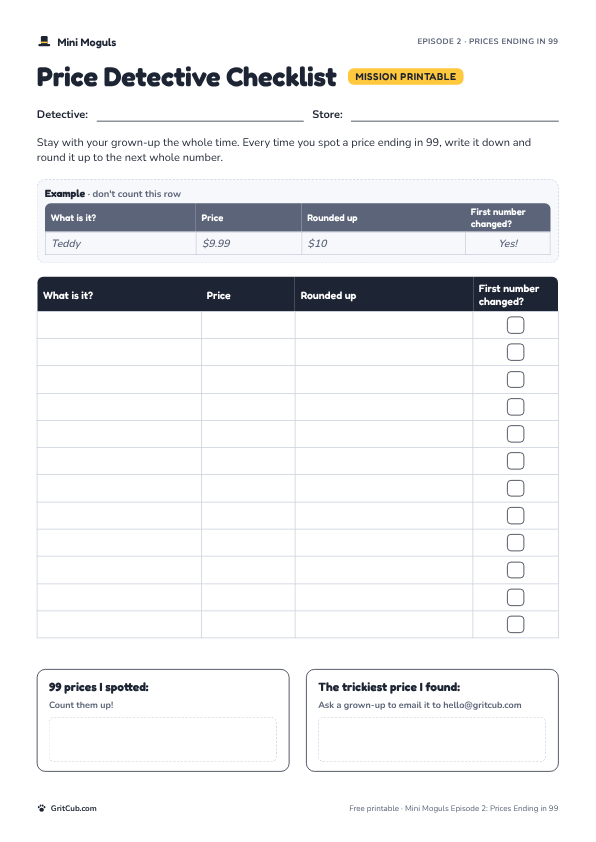
Price Detective Checklist
Take it on your next trip to the store. Write down every price that ends in 99, round it up, and check if the first number changed.
Charm Pricing
Why do so many prices end in 99? Maya leads the investigation with her price-tag gun, Leo tests the trick at his own bookmark stand, and you'll learn one quick way to see the real price.
Inside this episode
We read numbers from left to right, so the first number lands in our brain first. A slime set for $4.99 starts with a 4, so it feels like "four-something", even though it's only one cent away from $5.
Stores call this charm pricing. It works best when that one cent changes the first number. $2.99 feels a lot cheaper than $3.00, but $3.59 and $3.60 feel about the same, because they both start with a 3.
The way to stay in charge is to round it up. Jump to the next whole number, so $4.99 becomes $5 in your head. Then decide if you still want it.
In 2005, two scientists, Manoj Thomas and Vicki Morwitz, tested this. People judged $2.99 to be noticeably cheaper than $3.00, even though it's only one cent less. Researchers call it the left-digit effect.
A bit of both. The price is real, and you do pay a cent less, so the store isn't lying. But stores pick that number because they know our brains read the first number first. Rounding up keeps you in charge.
Try it at home
Next time you're in a store with a grown-up, become a price detective. Count how many prices end in 99, and round each one up out loud. A teddy for $9.99? That's $10.
Free mission printables
Take it on your next trip to the store. Write down every price that ends in 99, round it up, and check if the first number changed.
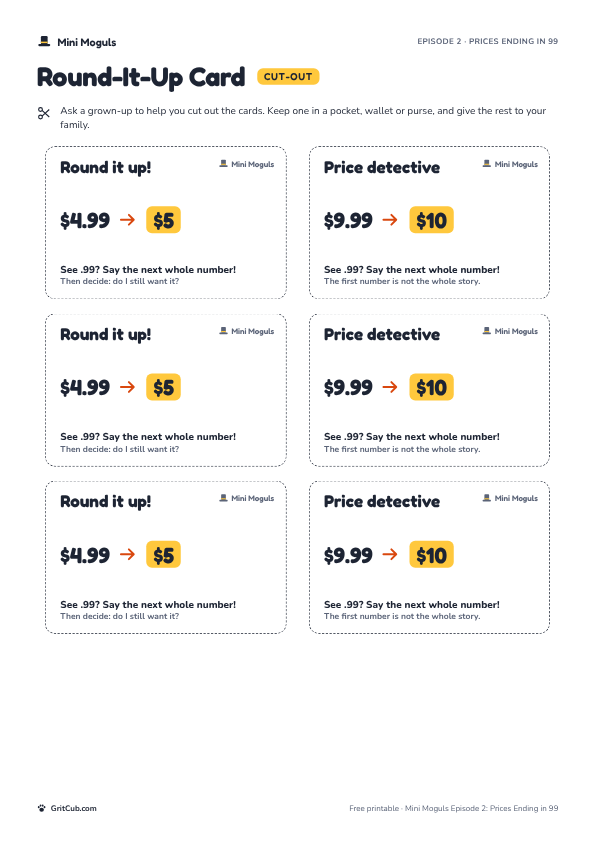
A wallet-sized reminder to keep in a pocket or purse. Six cards per page, so the whole family gets one.
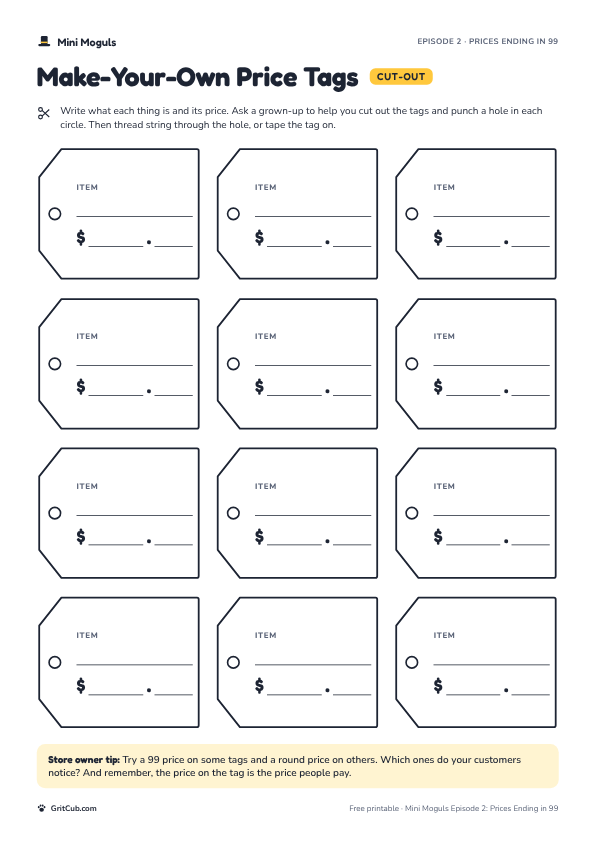
Twelve blank price tags for your own store at home. Price your toys, books and snacks, then open for business.
For grown-ups
Noticing that prices are picked on purpose, and asking why so many of them end in 99.
Understanding how stores choose prices while your child stays in charge of deciding what something is worth to them. When they run their own store at home, the price on the tag is the price people pay.
For the car ride home
Mini Moguls isn't connected to or paid by any store or company. The prices in this episode are made-up examples.
Sources we checked: