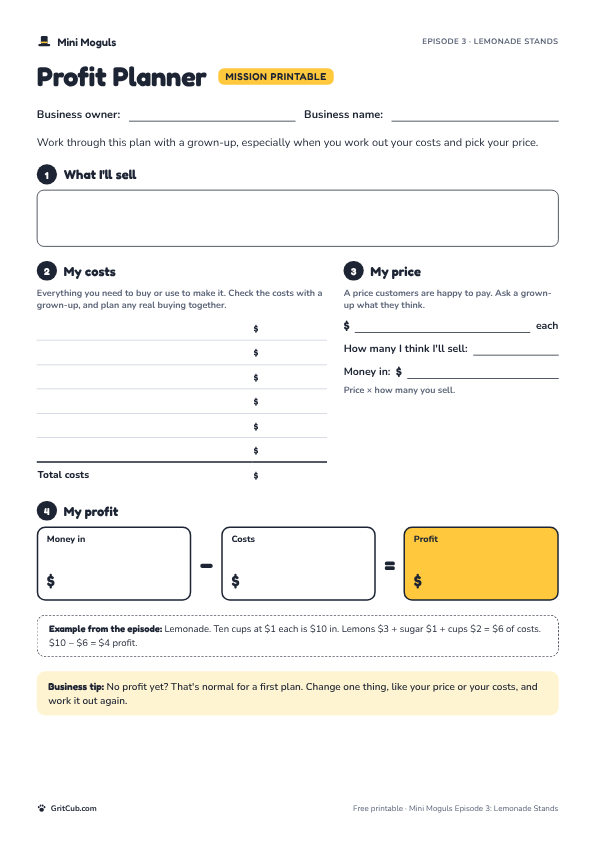
Profit Planner
Plan your own business in four steps: what you'll sell, what it costs, your price, and the profit you'll keep.
Profit and Costs
Maya and Leo's lemonade stand filled the money jar with $10. So why didn't they get to keep $10? Together they work out costs and profit, then test the idea on a friendship bracelet business.
Inside this episode
The money that comes in isn't all yours to keep. Before Maya and Leo sold a single cup, they spent $6 on lemons, sugar and cups. The money you spend to make the thing you sell is called your costs.
Take your costs away from the money that came in, and what's left is your profit. For the lemonade stand, that's $10 in, take away $6 of costs, which leaves $4 of profit.
A good price is one customers are happy to pay, so they keep coming back, and you still make some profit.
Ten friendship bracelets at $1 each bring in $10. The thread costs $3, so the profit is $7. Maya wanted to give a free treat with every bracelet, but a bag of ten treats costs $2, so the profit drops to $5. Her new plan is to try one day with treats and one day without, and see which day makes more profit.
Profit pays you for your work, like squeezing lemons all afternoon. It's also the reward for taking a chance: you spend money on supplies before anyone buys, and if nobody comes, you lose it. But charging way too much doesn't work either, because customers won't buy, or won't come back.
Try it at home
Pick something you'd love to sell, like drawings, bookmarks, or cakes made of playdough. Work out what it would cost to make, what price you'd charge, and how much profit you'd keep. Then set up your stand at home and get your family to be your customers.
Free mission printables
Plan your own business in four steps: what you'll sell, what it costs, your price, and the profit you'll keep.
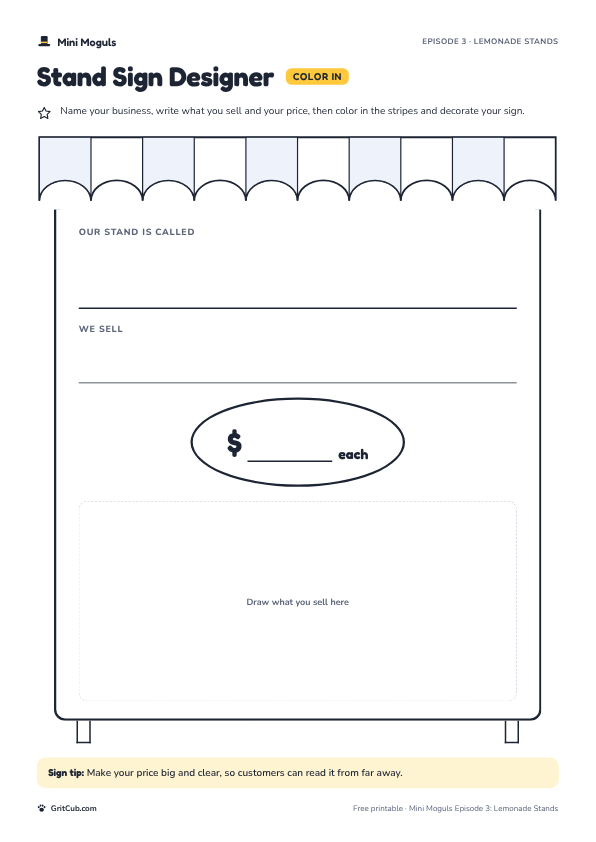
A big blank stand sign to name your business, show what you sell, and put your price where everyone can see it.
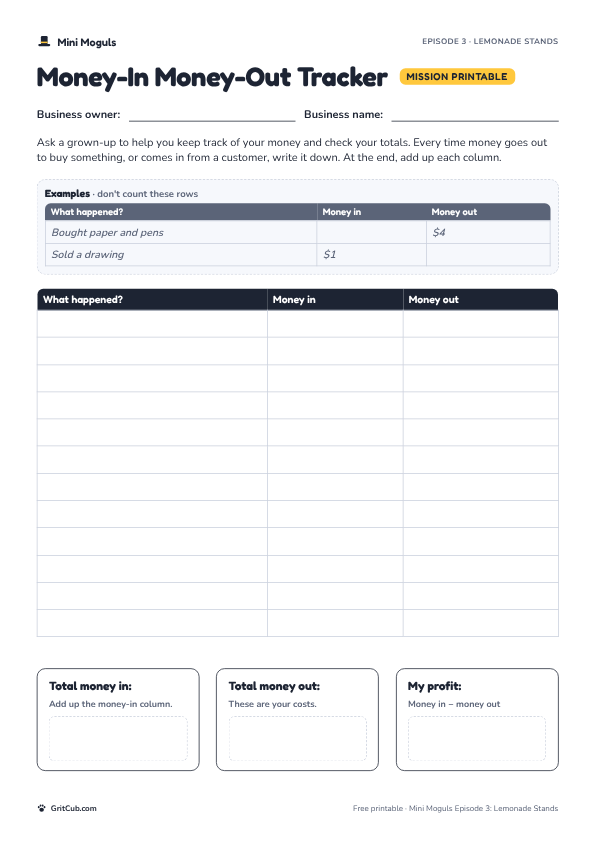
Keep track of your stand. Write down every bit of money that goes out on costs and comes in from customers, then work out your profit.
For grown-ups
Turning an idea into a real plan: counting the costs, picking a price, and opening a stand at home with family as customers.
When Maya's free-treat plan cut into the profit, she didn't give up. She made a new plan to test it. Changing a plan that doesn't work is part of running any business.
For the car ride home
All the numbers in this episode are made-up examples, and we've checked the math. Lemonade stands in Mini Moguls are run with a grown-up.